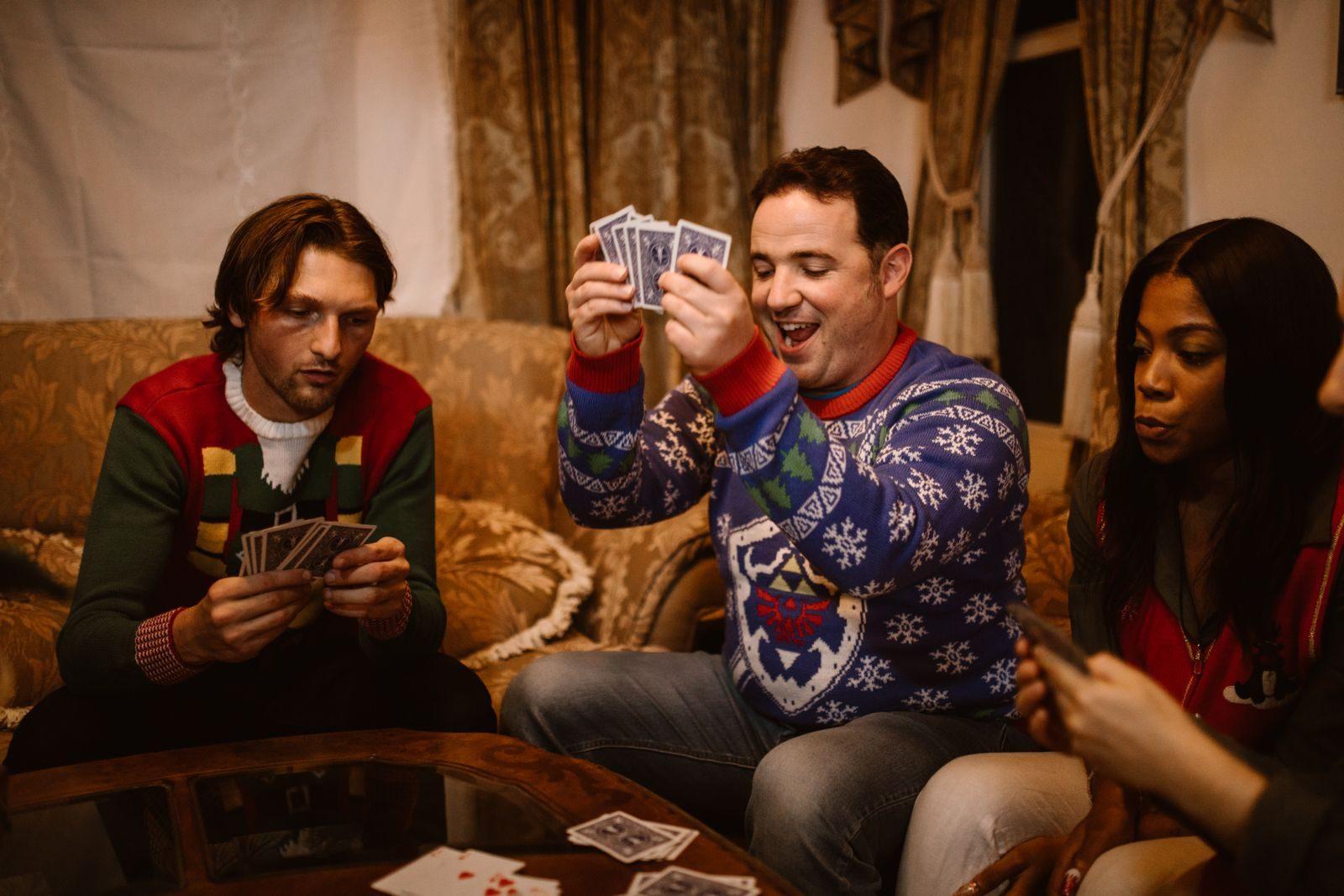
Hardly any programme item divides a team like the word "game". Some people light up, others start looking for the exit as soon as they hear it. Both are understandable: good games get people talking who otherwise never would. Bad ones put individuals on the spot in front of everyone.
The difference is almost never the game itself, it is how it is run. So first the rules, then ten ideas you can prepare even at short notice. All of them work without an agency and without a stage.
Four rules so nobody cringes
- Taking part is voluntary, watching is fine. Anyone who does not want to play does not have to explain. Good games are fun to watch too.
- Teams, not individuals. Nobody stands alone in the spotlight. In a team of four to six, everyone contributes as much as they want.
- Mixed teams. Games are the easiest chance to mix departments. Draw the teams or deliberately build them across departments.
- Keep it short. No game longer than thirty minutes, and at least forty-five minutes for eating and talking between two programme items.
1. The Christmas quiz
Preparation: 2 to 3 hours · Group size: 15 to 150
The classic, and rightly so. Five rounds of eight questions each: general Christmas knowledge, questions about your own company, a music round with Christmas songs in unusual versions, a picture round and an estimation round ("How many cups of coffee did we drink this year?"). Teams write their answers on slips, two hosts do the scoring.
2. Photo challenges on the big screen
Preparation: 15 minutes · Group size: 20 to 500
Photo challenges are the game for people who do not like games. A task appears on a screen, and whoever wants to takes a photo for it and uploads it via a QR code. There is no audience watching someone fail, just a wall slowly filling up with pictures.
With Evokato you add the challenges beforehand and have them appear on the wall spread across the evening. A few examples that work well at Christmas parties:
- A group photo with three people from three departments
- Your table as a nativity scene
- The most creative Christmas accessory in the room
- A photo with the person who has been at the company longest
- Something that sums up your year at the office
- The best snapshot from the buffet
Because the photos appear live on screen, the wall itself becomes a talking point. And after the party you have all the pictures in one place instead of hunting them down from twenty phones.
3. Name that Christmas song
Preparation: 1 hour · Group size: 10 to 200
Play the first five seconds of a Christmas song and the teams guess the title and artist. It gets harder with cover versions, intros played backwards or songs that are only hummed. A laptop and a speaker are all you need.
4. Who is this? Guess the baby photo
Preparation: 1 week to collect photos · Group size: 15 to 80
Ask for voluntary childhood photos beforehand and show them on the screen on the night. Teams guess who is behind each one. It works particularly well when management joins in, and it reliably gets people talking who barely know each other. Important: only with explicit consent, and nobody is pushed.
5. White elephant swap with a dice rule
Preparation: minimal · Group size: 10 to 60
Everyone brings a wrapped present they no longer need themselves. Players take turns rolling a die: on a six you take a parcel from the pile, on a one you may swap with someone. After a set time it stops and everyone unwraps. It is chaotic, entertaining and puts nobody on the spot.
6. Christmas Pictionary
Preparation: 30 minutes · Group size: 10 to 60
One person per team draws a word on a flip chart, the team guesses. Words like "reindeer", "advent wreath" or "year-end closing" quickly get a laugh. Anyone who does not want to draw just guesses along. A round lasts only a minute per team, which keeps the pace up.
7. Christmas party bingo
Preparation: 1 hour · Group size: 20 to 300
Instead of numbers, the bingo cards list things that might happen that evening: "Someone is wearing a Christmas jumper", "The speech runs over five minutes", "Someone spills mulled wine". Whoever completes a row shouts bingo. The game runs alongside everything else and needs no programme time of its own.
A getting-to-know-you variant: the squares list traits ("has been to Japan", "plays an instrument"), and you have to find someone they apply to.
8. Gingerbread house building contest
Preparation: buy the kits · Group size: 10 to 80
Each team gets a gingerbread house kit and thirty minutes. Judging covers stability, creativity and the best detail. The houses stay up as decoration afterwards, and the photos of them are among the most popular of the night.
9. The year in review guessing game
Preparation: 2 hours · Group size: 20 to 200
Collect twelve photos from the year, one per month, and show them in random order. Teams match each one to the right month. At the same time it celebrates what the team achieved, without anyone having to give a speech.
10. The closing slideshow
Preparation: none during the party · Group size: any size
Not a game as such, but a good ending: just before the official programme finishes, show all the photos of the evening as a slideshow. If you use a photo wall, you already have that slideshow on screen. It is the moment everyone comes together once more and laughs.
What you should leave out
- Games where individuals have to go on stage
- Drinking games
- Games involving physical contact
- Anything that makes jokes at the expense of individual people or departments
- Games that last longer than half an hour
Still at the very start of planning? Then our 12 ideas for a last-minute Christmas party and the checklist for a Christmas party in two weeks will help.
Frequently asked questions
How many games does a Christmas party need?
One or two fixed programme items are enough. On top of that you can add games that run alongside, like bingo or photo challenges. More than that quickly feels like a compulsory programme.
Which games suit large groups?
From around a hundred people, games work where not everyone has to take a turn at once: team quizzes, bingo and photo challenges on the big screen.
What if nobody wants to join in?
Start with a game where nobody can get it wrong, and ask two or three colleagues beforehand to go first. Once the first photos appear on the wall or the first team laughs, the others usually follow.
Do we need a host?
For a quiz, yes; two colleagues are enough. Bingo, photo challenges and the white elephant swap largely run themselves.
Photo challenges for your Christmas party? evokato.com/en/corporate has everything about Evokato for company events, or you can create an account straight away and try a wall for free.